


Create - Projects

A Partnership between

TfL & Technical Digital Media

divider

Intent

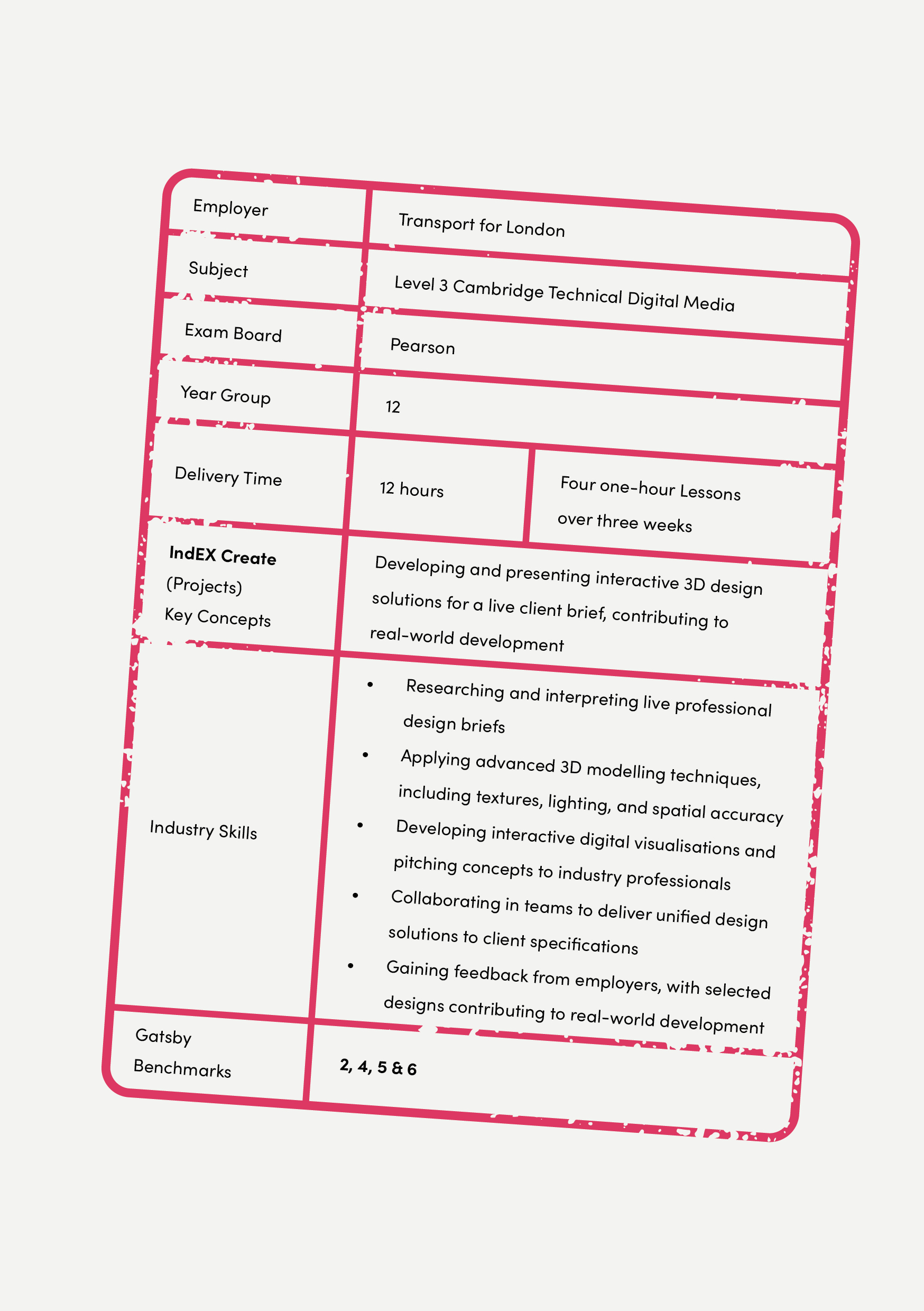
Even when learners are deeply engaged in creative and technical subjects, they often question how these skills connect to professional industries. Transport for London (TFL) provided an opportunity for learners to work on a real client brief, designing a 3D digital twin of the Royal Docks Cable Car Terminal. This allowed learners to see how advanced modelling, design, and presentation skills are applied in infrastructure, tourism, and urban planning sectors.

Implementation

Learners visited the Royal Docks Cable Car Terminal, meeting with TFL staff to understand the operational needs and design considerations of the site. Working in teams, learners created detailed 3D models using CAD software, incorporating textures, lighting, and spatial accuracy. Each team member contributed specialist elements before combining them into a unified digital twin. Learners then pitched their designs back to TFL representatives, receiving professional feedback on both technical execution and presentation skills.

Impact

Learners gained experience in meeting a live client brief, applying creative and technical skills to a professional standard, and presenting confidently to industry experts. This experience helped them understand how 3D modelling can be applied to real-world environments and infrastructure projects.

divider
divider

Learner Quote:

“It made me realise that the software skills I’ve been developing could actually be used to design real places that thousands of people visit every day, and in this case, actually get built!”

Teacher Quote:

“I was absolutely bowled over by the level of support that Transport for London provided. The time and expertise they invested gave our learners an experience that felt truly professional. I also came away having learnt about new and emerging technologies myself, which I can now take back into the classroom to enrich future lessons. It was an inspiring collaboration that raised aspirations for both staff and learners.”

Employer Quote:

“We were hugely impressed by the creativity and professionalism of the learners’ work. Their ability to translate a complex live brief into detailed 3D digital models was remarkable, and their confidence in presenting back to us demonstrated skills we value in our own teams. It’s inspiring to see young people applying their learning to real-world challenges, and we’re excited to think that some of these learners could be shaping London’s future infrastructure projects in years to come.”

divider

Further key concepts

While the main aim was to develop and present interactive 3D design solutions for a live client brief, the activity also reinforced broader concepts from the Cambridge Technical Digital Media specification. Learners enhanced their ability to research and interpret client briefs, apply advanced digital design techniques, and improve their outputs through professional feedback. The project involved teamwork, problem-solving, and critical evaluation, as learners collaborated to produce a cohesive digital solution.
By embedding these skills in a high-stakes, real-world context, the project made complex concepts more engaging and memorable, ensuring learners could revisit and confidently apply them during assessment.

divider
Industry Skill Exam Key Concept (Cambridge Technical Digital Media – Pearson)
Researching and interpreting live professional design briefs. Responding to briefs; pre-production planning; understanding client needs.
Applying advanced 3D modelling techniques (textures, lighting, spatial accuracy). Digital design techniques; technical execution; use of CAD and modelling software.
Developing interactive digital visualisations and pitching to professionals. Production and post-production; presentation of creative solutions; communication skills.
Collaborating in teams to deliver unified design solutions. Project management; teamwork and coordination; applying work-flows in creative industries.
Gaining feedback from employers with selected designs contributing to real-world development. Evaluation and refinement; responding to professional standards; iterative improvement.
  • close

Get in contact with us!