




Inspire - Masterclasses

A Partnership between

Google & A Level Psychology

divider

Intent

Psychology learners are often curious about how theories of cognition and aggression translate into real-world contexts. Partnering with a Google Machine Learning Engineer allowed learners to apply their studies to meaningful, open-ended challenges that linked directly to mental health, online safety, and user experience design.

Implementation

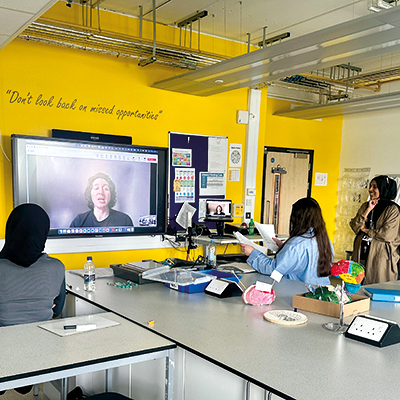
Year 12 focused on abnormalities, tackling the question: “How might we enable adolescents to have positive mental health and well-being?” They explored topics such as anxiety, depression, neurodiversity, and the stigmatisation of mental health, generating innovative ideas to support adolescent well-being through the design and creation of user interfaces for apps they hope to develop further. Year 13 applied their knowledge of aggression to the challenge: “How might we enable teenagers to stay safe online with aggressive social media?” Learners used design thinking processes to explore local and online aggression, always considering the impact on cognition. Working closely with Google, they developed practical solutions, including Translatism, a prototype social media interpreter to help neurodivergent and neurotypical young people communicate safely online as there is a gap for this important and unmet need. Throughout the projects, learners were introduced to professional UX design tools and processes, deepening their understanding of how psychology informs digital innovation.

Impact

Learners gained a richer understanding of psychology through practical application, linking theory to pressing real-world issues. They developed confidence in presenting to a global employer, applied creative problem-solving skills, and produced solutions that impressed both their teacher and industry mentor.
divider
divider

Learner Quote:

“Working with Google showed us how psychology can actually help solve big issues like mental health and online safety. It made the subject feel so much more relevant.”

Teacher Quote:

“I have been amazed by the creativity, seriousness, and innovation displayed by these young people. Some even created AI prototypes with fantastic user interfaces based entirely on user feedback. They have seamlessly linked our curriculum to current world problems, and this is where industry is at. The year 13s’ final presentation occurred during an OFSTED visit and the inspector was “blown away by what he saw in Psychology.” And how Google was so impressed by the “industry standard design and thinking shown and developed.”

Employer Quote:

“What I saw from the learners is what I’d expect to see from my colleagues at Google, not school learners! Their ideas were fresh, ambitious, and genuinely inspiring.”

divider

Further key concepts

This masterclass reinforced key areas of the AQA Psychology specification. Beyond applying theories of cognition, abnormalities, and aggression to real-world contexts, learners explored mental health interventions, the influence of digital environments, and cultural and social factors shaping behaviour. Using design thinking and solution-focused approaches, they strengthened their ability to apply psychology beyond the classroom while developing critical evaluation, research, and problem-solving skills.

divider
Industry Skill Exam Key Concepts (AQA A Level Psychology)
Applying design thinking to psychology challenges. Research methods; developing and refining hypotheses; problem-solving in applied contexts; Data collection, analyses and presentation as part of data science in Psychology.
Connecting cognition, abnormalities, and aggression to real-world contexts. Psychopathology (OCD, depression, phobias); cognitive psychology; social influences on aggression.
Designing solutions to support adolescent mental health. Applications of psychological research to mental health and well-being; treatments of mental disorders.
Developing teamwork, communication, and presentation skills. Ethical issues in psychological research; working collaboratively; communicating psychological findings.
Translating psychological theory into practical applications with a technology lens. Cognitive neuroscience; the role of digital environments in behaviour; implications of psychology for contemporary society.
  • close

Get in contact with us!